
When a small band of tissue holds your tongue or lip too tightly in place, simple actions like eating, speaking, and even breathing can become unexpectedly difficult. A frenectomy is the dental procedure that releases that tissue, and for many patients, it changes everything.
At Richard Hardt’s Live Oak Dental Group, Dr. Richard Hardt, Dr. Irene Cruz, and Dr. Jackson Lewis help patients throughout Porterville understand whether this procedure may be the right step for them. Whether you are a parent concerned about your infant’s feeding or an adult dealing with a gap between your front teeth, our tongue-tie treatment can offer major relief. Our team approaches every case with warmth, patience, and the advanced tools needed to give you an accurate answer.
What Is a Frenectomy?
Your mouth contains small folds of tissue called frenula. You have one beneath your tongue, called the lingual frenulum, and one connecting your upper lip to your gums, called the labial frenulum. In most people, these tissue bands are flexible enough to allow normal movement. When they are unusually thick, short, or tightly attached, movement becomes restricted, and problems follow.
A frenectomy removes or releases this tissue to restore proper function. The procedure is quick and minimally invasive and can be performed with a diode laser or traditional instruments, depending on what is most appropriate for your case.
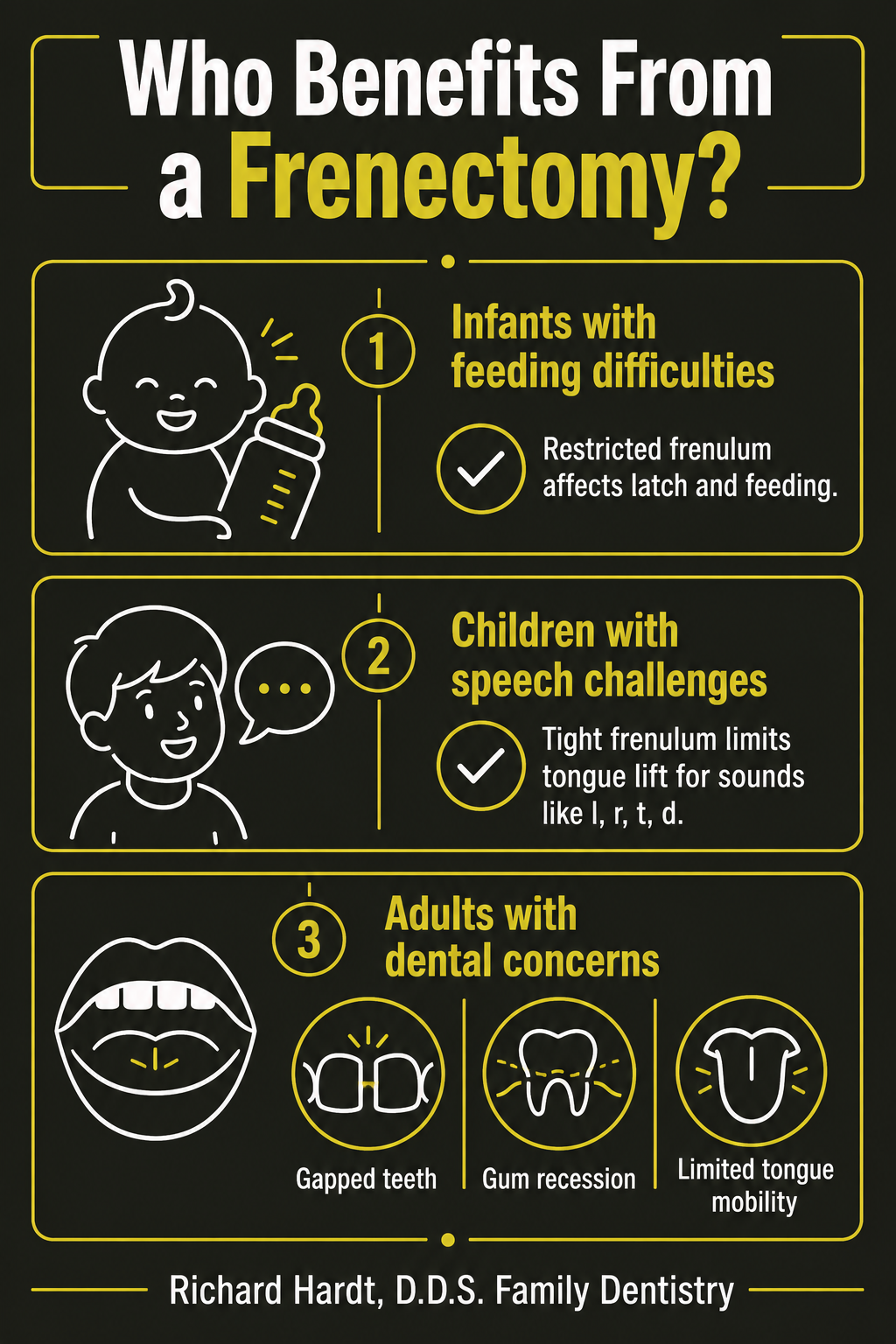
Who Benefits From a Frenectomy?
Many patients are surprised to learn that frenulum restriction affects people at every stage of life, from newborns struggling to feed to adults dealing with unexplained gum recession. The most common groups who may benefit from an evaluation include the following:
Infants With Feeding Difficulties
Tongue tie is one of the most commonly discussed reasons for frenectomy in infants. A restricted lingual frenulum can prevent a baby from latching properly onto the breast or bottle, leading to frustration, poor weight gain, and discomfort for both the child and the nursing parent.
If feeding has been a struggle since birth and other causes have been ruled out, a frenectomy evaluation is worth pursuing. The procedure itself takes only minutes, and recovery is typically smooth.
Children With Speech Challenges
Some children reach speaking age and have difficulty producing certain sounds clearly. Sounds like “l,” “r,” “t,” “d,” “n,” and “th” require the tongue to lift toward the roof of the mouth, and when the lingual frenulum is too short or tight, that lift is restricted. According to research published in PubMed, frenectomy for tongue-tie is associated with measurable improvements in speech articulation, and earlier treatment tends to produce better outcomes.
Not every speech issue is caused by tongue tie, and a thorough evaluation is necessary before recommending treatment. When tongue tie is identified as a contributing factor, releasing the frenulum often helps speech therapy produce faster and more lasting results.
Adults With Specific Dental Concerns
Frenectomy is not only for children. Adults seek this procedure for a range of reasons, and many have lived with the underlying restriction for years without realizing treatment was available. Common signs an adult needs a frenectomy include:
- Gapped front teeth: A thick or low labial frenulum can push the two upper front teeth apart, creating a persistent gap that resists orthodontic correction. Removing or repositioning the frenulum helps the teeth stay closed after treatment.
- Gum recession: When the labial frenulum pulls too tightly against the gum tissue, it can contribute to recession over time, exposing tooth roots and increasing sensitivity.
- Tongue mobility limitations: Some adults have lived with a restricted lingual frenulum for years without knowing it. Symptoms may include difficulty pronouncing certain words, trouble eating certain foods, or tension in the tongue and jaw.
A simple evaluation is all it takes to determine whether frenulum restriction is contributing to any of these concerns.
What the Frenectomy Procedure Involves
A frenectomy at Richard Hardt’s Live Oak Dental Group is a straightforward outpatient procedure. After a topical numbing agent or local anesthetic is applied, the frenulum tissue is carefully released using our diode laser. Laser treatment allows for precise incisions with less bleeding, reduced discomfort, and faster healing compared to traditional techniques.
The appointment is brief, and most patients return to normal activities quickly. There may be some mild soreness in the days that follow, and we will send you home with clear post-operative instructions to support smooth healing.
When to Ask About a Frenectomy
You may want to schedule an evaluation if you or your child has struggled with any of the following: persistent feeding difficulties in infancy, delayed or unclear speech development, a noticeable gap between the front teeth, gum recession near the front of the mouth, or limited tongue movement that affects daily function.
Adults who have lived with these symptoms for years sometimes assume this is their permanent reality. In many cases, a brief procedure offers a meaningful improvement in quality of life.
Richard Hardt’s Live Oak Dental Group Is Here to Help
Dr. Hardt, a graduate of Loma Linda University with more than 34 years of dental experience, leads a team that includes Dr. Irene Cruz, who is fluent in Spanish and recognized for academic excellence, and Dr. Jackson Lewis. Together, they bring the knowledge and compassion needed to evaluate each patient thoroughly and recommend treatment only when it is genuinely appropriate.
Richard Hardt’s Live Oak Dental Group has been recognized as Porterville’s best dental practice by the Porterville Recorder Reader’s Choice Award for multiple consecutive years, a testament to the trust this community places in our care. If you suspect that a tight frenulum may be affecting your health or your child’s development, we encourage you to reach out. Contact us today to schedule a consultation and get the answers you need.
