You want a better smile, but somewhere in the back of your mind, a nagging question lingers: is what’s going on with your teeth a matter of appearance, or is something more serious at play? These two concerns can feel similar on the surface, yet the answers point to very different paths of care. Cosmetic dentistry addresses how a smile looks, while reconstructive dentistry addresses how it functions and survives. Knowing which one you actually need can save you time, money, and a great deal of discomfort.
At Richard Hardt’s Live Oak Dental Group, our team understands that every smile tells a story, and sometimes that story includes damage, decay, or structural challenges that go far beyond what a whitening treatment or veneer can fix. Led by Dr. Richard Hardt, Dr. Irene Cruz, and Dr. Jackson Lewis, our Porterville practice offers a full range of restorative dentistry options designed to rebuild smiles from the ground up, with the same warmth and attention you’d expect from a trusted family practice.
Understanding the Difference Between Cosmetic and Reconstructive Care
Cosmetic procedures improve the appearance of otherwise healthy teeth. Think teeth whitening, porcelain veneers, or clear aligners. These treatments make a good smile look great. Reconstructive dentistry, by contrast, steps in when teeth are no longer structurally sound, when oral function has been compromised, or when the foundation of a healthy mouth needs to be reestablished before anything else is possible.
Many patients arrive at a dental office wanting one treatment and discovering they need another. According to the National Institute of Dental and Craniofacial Research, adults aged 20 to 64 have an average of 25.5 remaining teeth, meaning most adults in that age range have already experienced some form of tooth loss. When damage or loss reaches a certain threshold, cosmetic fixes simply won’t hold without a solid structural foundation beneath them.
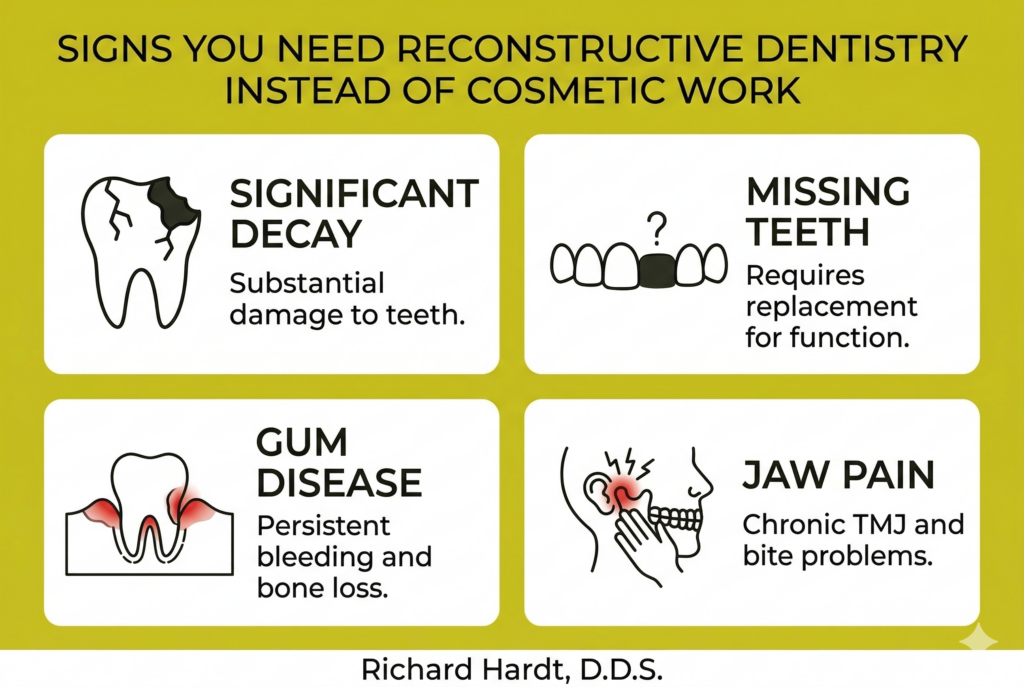
Signs That Reconstructive Dentistry May Be the Right Path
There are several indicators that what your smile needs goes beyond cosmetic improvement. Not every cracked tooth or discolored surface is a cosmetic problem, and recognizing the difference early leads to better, longer-lasting outcomes.
You Have Significant Tooth Decay or Damage
Surface staining is cosmetic. Deep decay, however, is a structural issue. When a tooth has decay that reaches the inner pulp, or when a tooth has cracked in a way that compromises its stability, the problem must be repaired. Dental crowns and root canal therapy are reconstructive solutions that restore a tooth’s integrity, allowing it to continue to serve its function without risk of further breakdown.
You Are Missing One or More Teeth
A gap in your smile may look like a cosmetic concern, but the effects of tooth loss ripple throughout the entire mouth. Neighboring teeth drift into the space, the jawbone begins to lose density without a root stimulating it, and bite alignment can shift in ways that create new problems over time. Dental implants and dental bridges address these structural consequences directly by replacing both the appearance and the function of what was lost.
Your Gums Show Signs of Disease
Cosmetic work performed over unhealthy gum tissue is unlikely to last. Gum disease, particularly in its more advanced stages, undermines the very structures that hold teeth in place. Before any aesthetic improvement can be planned, gum health must be restored. Gum disease treatment is a prerequisite, not a side note, when periodontal problems are present.
You Experience Chronic Pain, Bite Problems, or Jaw Discomfort
Pain is rarely cosmetic. If you regularly experience toothaches, sensitivity when biting, jaw soreness, or headaches that seem related to your teeth, these are signals that something functional is off. TMD, bite misalignment, and worn-down teeth all fall within the reconstructive umbrella. Treating the underlying cause of discomfort creates a stable platform from which cosmetic improvements, if desired, can then be made.
When Cosmetic and Reconstructive Care Overlap
It’s worth noting that these two categories are not always separate conversations. A complete smile makeover often involves both reconstructive and cosmetic elements working together. For example, a patient who needs full-mouth restoration may receive crowns and implants that also dramatically improve the appearance of their smile. The functional work and the aesthetic outcome arrive together.
The key distinction is sequence. Reconstructive needs come first. A patient who wants veneers but has untreated decay will need the decay addressed before moving forward. This isn’t a detour; it’s the foundation that makes the cosmetic outcome more effective and durable.
Reach Out to Richard Hardt’s Live Oak Dental Group in Porterville
If you’ve been wondering whether your dental concerns fall into the cosmetic or reconstructive category, the most helpful next step is a conversation with a team that can take a complete look at your oral health. At Richard Hardt’s Live Oak Dental Group, Dr. Hardt and Dr. Jackson Lewis bring decades of combined experience to every evaluation, using advanced technology and a genuine commitment to your well-being to help you understand exactly where you stand and what your options are.
Whether you need comprehensive restoration, a targeted repair, or simply clarity on what path forward makes the most sense for your smile, our team is here to guide you with honesty and care. Contact our office to schedule your consultation and take the first step toward a smile that is not only beautiful but built to last.
